· Julie Grunklee · Healthy Recipes · 5 min read
Cooking Winter Squash
One of the easiest vegetables you can grow and cook is winter squash.
One of the easiest vegetables you can grow and cook is winter squash. My mother-in-law exposed me to winter squash about 25 years ago and now we devote almost 1/2 our garden to several varieties every year. We usually plant spaghetti, butternut, banana (yes, this is a real squash category!), pumpkins and sometimes delicata. Let’s take a look at the different kinds of winter squash & how simple it is to cook them.
Growing & Caring for Winter Squash
Winter squash is a viney crop and will take over space in a hurry. We have a large piece of heavy-duty plastic mulch left over from our farmer’s market days. We cut 4-6 inch square in it where we plant the squash. We use the mulch to prevent weeds from taking over later in the season when it would be a real challenge to weed without stepping on or injuring the vines.
We’ll also place a flag in that hole, so we know where to water if need be. No need to waste water where there’s no roots to absorb it.
Winter squash lasts for months after it’s harvested. We generally pick them in September or October & use them to decorate our front door until it threatens to freeze too hard. Then we move them into totes in the back porch for storage where they will keep til March.
We also give a fair amount away-as 1 plant can produce upwards of 5-10 squash. That’s a lot of squash.
You can buy winter squash in the grocery store or at the farmer’s market & it will keep just like ours do if you store it at about 50F. Cool enough to keep it from spoiling and warm enough to keep it from freezing. It won’t last as long in the refrigerator. A porch or cooler room that won’t freeze is your best bet.
Different Kinds of Winter Squash
Winter squash has a firm, dense flesh, whereas summer squash is usually more tender and easier to cut. Some winter squash is sweet, like a sweet potato and others are not.
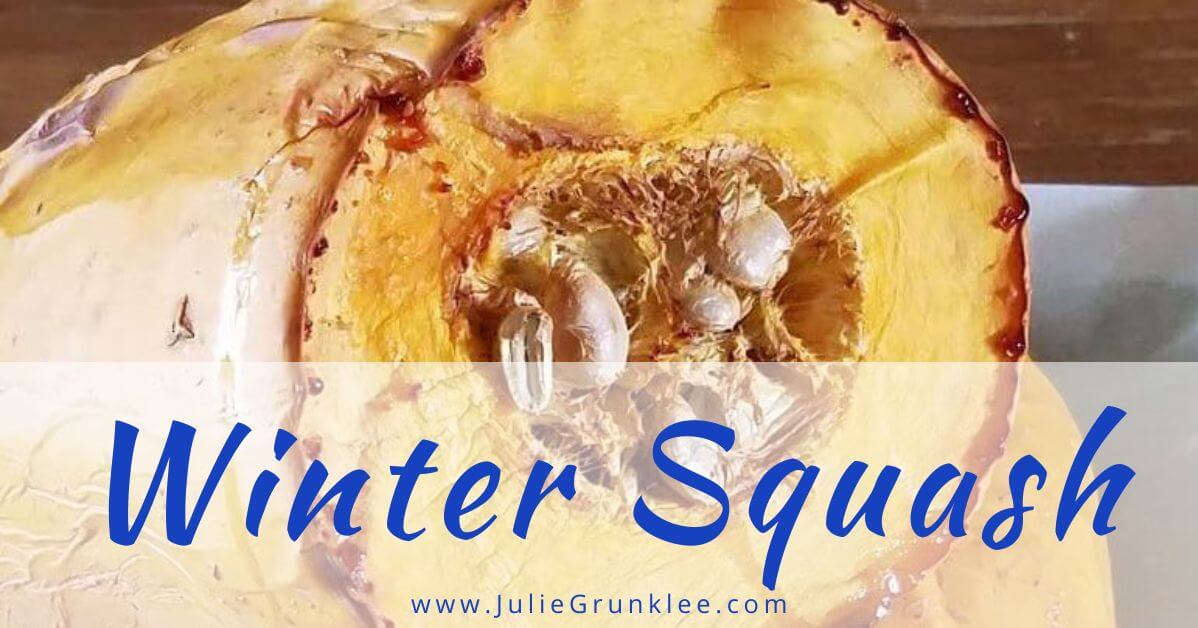
Butternut, delicate, butter cup, some pumpkins and banana squash usually have this flavor. You may be asking what a banana squash is. Its a banana shaped, thinner pinkish colored skinned (yes you can eat the skin like a potato), is about 24-36 inches long and 8 inches in diameter. It has the same flavor as a butternut, but the water content is higher so it mashes easier. The photo is a banana cut in 1/2.
Spaghetti squash is just like it sounds. The flesh is very stringy just like spaghetti. It’s a great alternative to pasta. It sometimes has a bit of sweetness, but not so much that it will throw off an Alfredo or spaghetti sauce.
Acorn, hubbard & many pumpkin varieties have more of a savory flavor to them. All are great with butter & some salt & pepper. I know many people who like brown sugar and/or marshmallows & cinnamon on their squash, but I wouldn’t try it with spaghetti or you’ll be sorely disappointed. I find the squash itself is sweet enough and don’t need the added sweeteners.
Cooking Winter Squash
For someone who doesn’t like to cook, squash is one of the easiest, delicious and nutritious foods to cook. The only thing you really need is time-perfect for these cold winter days. Here’s how:
Directions
Choose a squash. There are several varieties & sizes. The larger the squash, the longer the cook time.
Oven Method
- Poke a knife into the squash 1-3 times. (Just 1 hole will prevent it from exploding.)
- Place on parchment lined cookie sheet or baking dish.
- Bake at 350F for 1-1 ½ hours or until squash is soft when poked with a fork or knife.
- Allow to cool & cut in half lengthwise.
- Scoop out seeds, then scoop out flesh.
- If it’s a spaghetti squash, you’ll want to fork out the flesh as it will be stringy like spaghetti.
- For other squash, you can eat it without further processing, or mash it with a potato masher or fork.
Microwave Method
- Place squash on large microwave-safe plate.
- Poke 1-3 holes in it.
- Microwave on high for 5 minutes or until squash is soft enough to cut in half lengthwise.
- Place 1 half face down on the plate & microwave on high for another 5-7 minutes or until squash is soft when poked with a knife or fork.
- Repeat with other half.
- Let cool, scoop out seeds, then flesh as directed above.
Combined Method
- Place squash on large microwave-safe plate.
- Poke 1-3 holes in it.
- Microwave on high for 5 minutes or until squash is soft enough to cut in half lengthwise.
- Cut in half lengthwise & place each half face down on a parchment lined cookie sheet or baking dish.
- Bake at 350F for 1-1 ½ hours or until the squash is soft when you poke it with a fork or knife.
- Then follow directions as above.
Julie’s Notes
- You can scoop out the seeds as soon as you can cut it in half.
- I like to roast it with the seeds in to give it a bit more of a nutty flavor.
- I like to use spaghetti squash as a pasta substitute as well as a regular vegetable.
- Spaghetti squash works well with spaghetti sauce, Alfredo, etc.
- The more savory varieties are also delicious stuffed with meat & veggies (& cheese).
- I like to just add a bit of lard or butter with some salt & maybe pepper to most squash I eat.
- You could top with a teaspoon of brown sugar, honey, maple syrup or a few marshmallows. It’s usually sweet enough on its own.
- Uncooked squash keeps for months in a cool (50ish degrees) and dry place.
- Cooked squash keeps in the fridge for 3-4 days & freezes very well in freezer bags.
- You can use most squash (except spaghetti) in place of pumpkin in recipes (pie, bars, bread).